
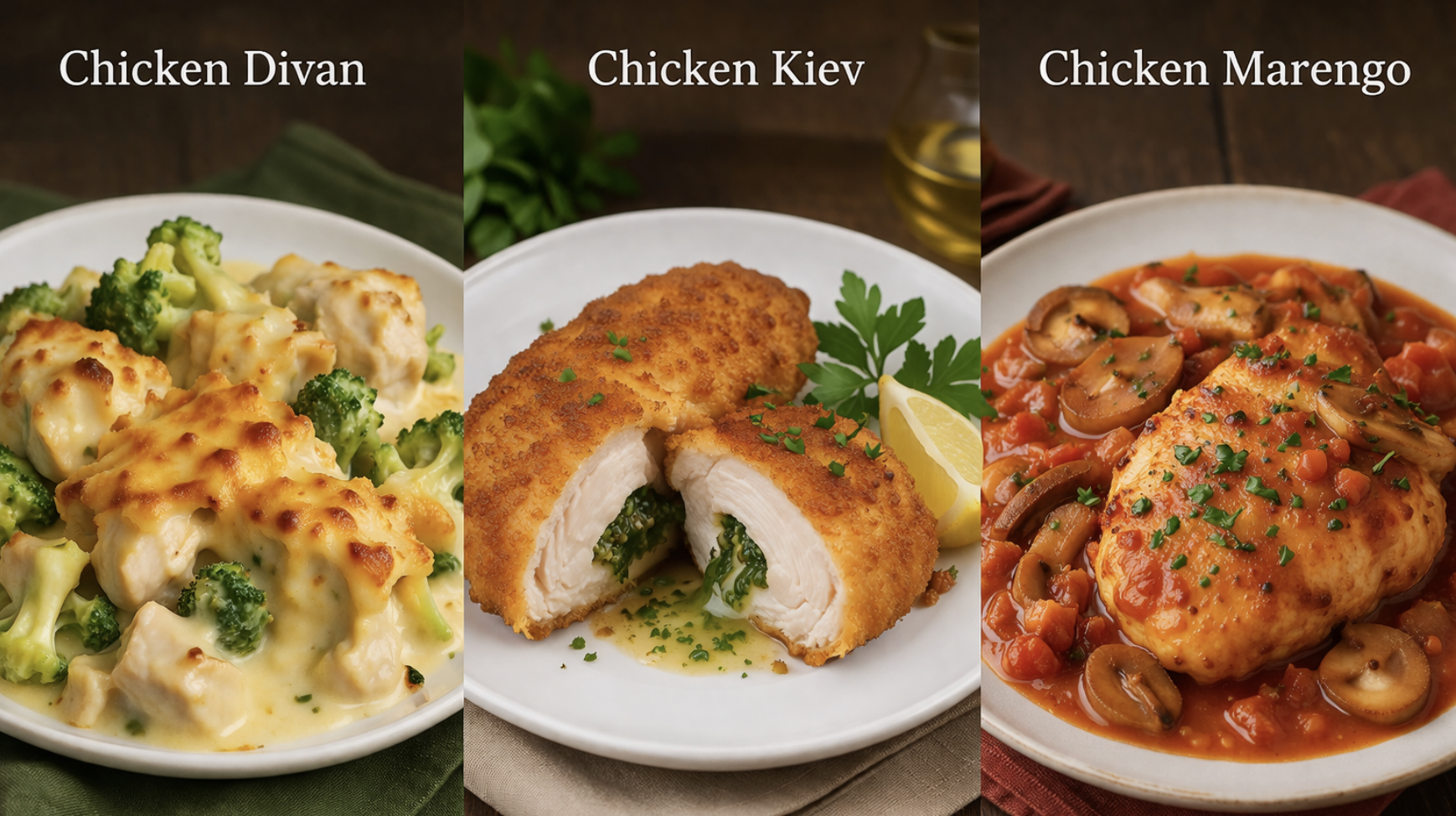
Chicken Divan:
A chicken casserole dish with broccoli and mornay or hollandaise sauce.
Chicken Divan was the signature dish of a 1950s New York restaurant, the Divan Parisienne. In English, the word “divan” came to mean sofa, from the council chamber’s benches. In France it meant a meeting place or great hall. It was this meaning that attracted the notice of the owners of the New York restaurant as they searched for a name that would imply continental elegance.
Chicken Kiev (kee-EHV):
Also called Tsiplenok Po-Kievski. A boned and flattened chicken breast that is then rolled around a chilled piece of herb butter. It is then breaded and fried. This poultry dish is also called “Chicken Supreme.”
This famous method of preparing chicken or pheasant is not of Russian origin as the name Kiev would imply. It was invented by the Frenchman, Nicolas (Francois) Appert (1749-1841), brewer, pickler, confectioner, and chef who discovered the principles of canning and preserving of food. Empress Elizabeth Petrovna (1741–1762) of Russia preferred French foods and fashions, and by the late 18th century wealthy Russian households were hiring French chefs, or sending their cooks to train in France. Because of this, French dishes were widely imitated.
Russian cookbooks have recipes for a similar dish called “celettes de volaille,” and not Kiev. It is generally thought that early New York restaurants trying to please the Russian immigrants gave the name Kiev. The name went back to Europe and is and was used in many places to describe Chicken Supreme. After World War II, Chicken Kiev became popular in Russian restaurants.
Chicken Marengo:
Originally made with crayfish and chicken. Today, the crayfish is usually left out. Chicken Marengo today is chicken cut into pieces, browned in oil, and then cooked slowly with peeled tomatoes, crushed garlic, parsley, white wine and cognac, seasoned with crushed pepper and served with fried eggs on the side (with or without crayfish, also on the side) and toast or croutons, doubling as Dunand’s army bread.
This dish was cooked for Bonaparte Napoleon’s (French emperor, by his chef, Dunand, after the Battle of Marengo in 1800. It was at Marengo, situated south of Turin, in the Italian province of Piedmont, that Napoleon defeated the Austrians on June 14, 1800, in a battle which he regarded as the most brilliant of this career.
Napoleon, as was his habit, had not eaten before the battle, and was famished. He demanded an immediate meal. Dunand was desperate and searched in the village of Marengo for any available ingredients to make the meal. What he could find was a combination of chicken and crayfish, tomatoes, eggs, and garlic. Dunand decorated the dish with “soldiers Biscuits (emergency-ration bread),” today, replaced by toast. Napoleon found the dish excellent and ordered that it be served after every battle. Napoleon was highly superstitious and chicken with crayfish was associated in his mind with victory.
.png)