
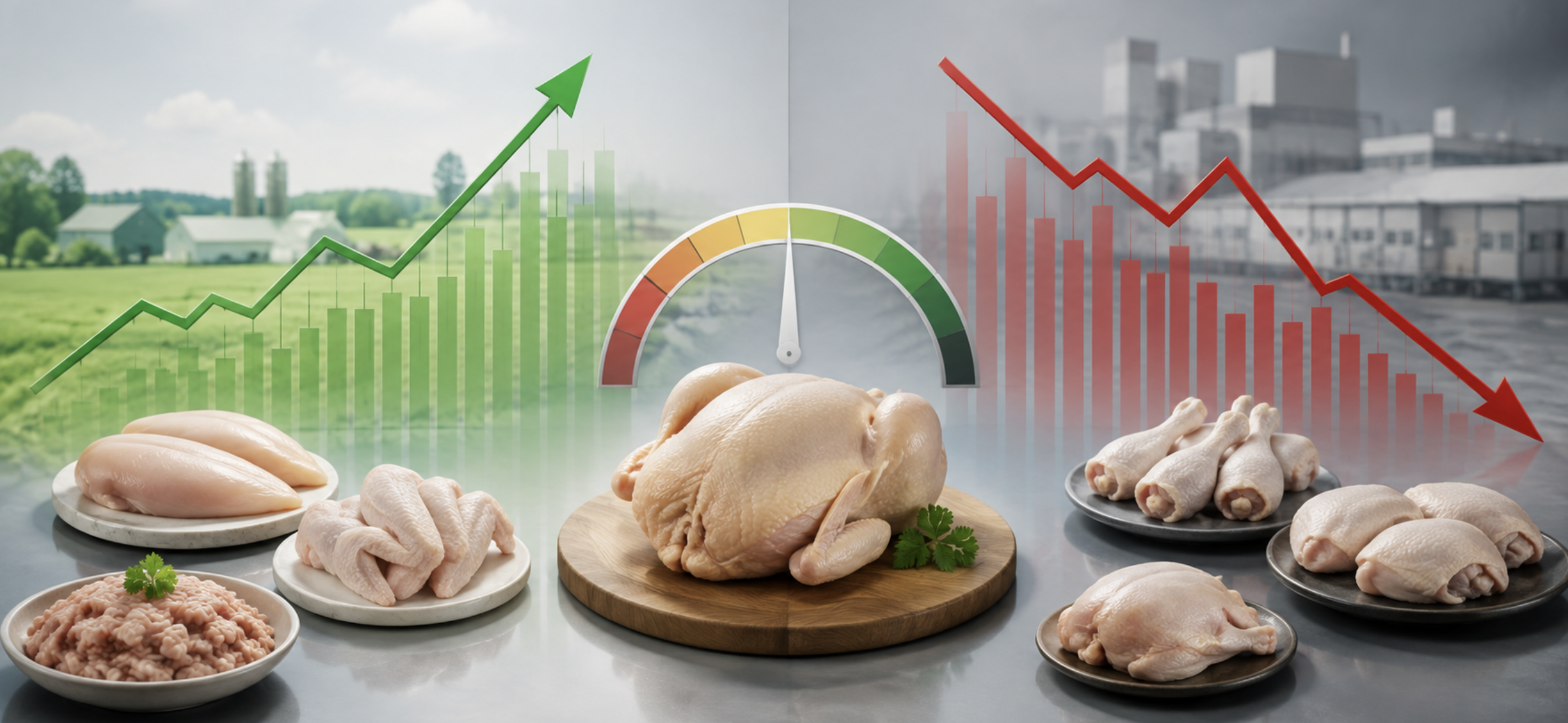
The overall broiler price index ended a six-week decline, posting a modest 0.2% increase to 118.04 cents per pound. This is an important psychological milestone, suggesting that the market has found an equilibrium zone in the 117–118 cents/lb range. However, the broader picture remains mixed: sales volume fell sharply by 5.9% to 8.925 million pounds, indicating not so much a stabilization of demand as a noticeable contraction amid ongoing market uncertainty.
The major development of the week was the sharp decline in the large bird segment and the unexpected weakness of dark meat. The market has become increasingly polarized: small birds continue to perform well, while processors have sharply reduced their interest in heavy broilers. This trend offsets gains in stronger-performing categories seen in previous weeks.
Premium segment (white meat)
The premium white meat segment failed to maintain stability. Chicken breast, which had shown signs of stabilization the previous week, declined 3.1% to 122.41 cents/lb, while sales volume decreased 4.7%. Breast fillets proved more resilient, slipping only 0.4% to 129.11 cents/lb. This suggests that price pressure on premium white meat remains significant, although there are no signs of panic selling.
Wings
Chicken wings, previously the market's strongest performer, reversed course. After rising 3.8% the week before, wing prices corrected downward by 1.1% to 123.68 cents/lb, while sales volumes fell 11.0%. Strong buying enthusiasm has cooled, and—as previously anticipated—buyers appear to be waiting for more attractive prices, which are now beginning to emerge.
Dark meat
Dark meat entered a deep correction, completely losing its previous momentum. What had initially appeared to be a gradual cooling accelerated significantly during Week 31. Drumstick prices fell 5.8% to 57.90 cents/lb, while sales volumes nearly halved (-47.7%). Leg quarters declined 6.6% to 55.68 cents/lb, despite a 7.2% increase in sales volumes, suggesting that sellers are actively moving inventory before prices fall even further. This no longer appears to be a normal correction following unusually strong gains, but rather a wave of loss realization and declining confidence in the dark meat market.
Mechanically deboned meat (MDM)
Mechanically deboned meat (MDM) once again confirmed its status as the market's defensive product. Prices remained virtually unchanged at 24.82–24.83 cents/lb, despite a 10.1% decline in sales volumes. This segment continues to provide remarkable price stability during periods of heightened market volatility.
Weight category analysis
The data indicate a clear shift in processor preferences.
Small birds (under 2.5 lbs)
This was the only segment to maintain positive momentum. Prices increased 0.4% to 136.48 cents/lb, although volumes declined 5.1%. This reflects continued premium demand.
Medium birds (2.51–3.5 lbs)
The mainstream market posted only a marginal 0.5% price increase to 115.65 cents/lb, while sales volumes dropped 6.5%, indicating weakening interest in this category.
Large birds (over 3.5 lbs)
Large broilers were the biggest disappointment of the week. Prices dropped 4.4% to 89.08 cents/lb, while sales volumes declined 10.5%. Processors, who had previously increased purchases following lower prices, have now sharply pulled back from the market. This represents a strong bearish signal.
Market outlook
The market transition from correction to consolidation, which appeared to be developing during Week 30, is now in question. Instead of broad-based stabilization, the market is becoming increasingly polarized: defensive products such as mechanically deboned meat and small birds remain relatively stable; products linked to foodservice, grilling and further processing, including large birds and dark meat, continue to weaken at an accelerating pace.
Expectations that China's market reopening would support demand across multiple product categories have not yet materialized. The overall broiler index is likely to remain within the 117–118 cents/lb range, supported primarily by strong prices for small birds. However, the market's internal structure is deteriorating rapidly.
If processors continue to withdraw from the large bird segment and demand for dark meat remains weak, downward pressure on the overall market index is likely to intensify as early as next week. The next key level to watch is whether the index can maintain the psychologically important 117.00 cents/lb threshold. For now, the market appears to be searching for a bottom rather than preparing for a recovery.
.png)